
Article: Ergothioneine: The Mushroom Nutrient Emerging in the Science of Healthy Ageing

Ergothioneine: The Mushroom Nutrient Emerging in the Science of Healthy Ageing
Why scientists are taking a closer look at this unusual compound, and why mushrooms sit at the centre of the story
For more than a century, a little-known compound called ergothioneine has been quietly sitting within our food supply.
First identified in 1909, ergothioneine, commonly abbreviated to EGT or ET - is a naturally occurring sulphur-containing amino acid derivative. Unlike nutrients that humans can manufacture internally, ergothioneine must be obtained through the diet.
What makes the story particularly interesting is where it comes from.
Humans do not make ergothioneine.
Plants do not appear to manufacture it either.
Its biological origins lie primarily with fungi and certain microorganisms.
And among the richest dietary sources identified to date are mushrooms.
This connection between fungi, food and human physiology has attracted increasing scientific interest, particularly as researchers investigate whether ergothioneine may have a role in protecting cellular function during ageing.
So much so that ergothioneine has been proposed by some researchers as a possible “longevity vitamin” , not because it has officially been classified as a vitamin, but because it may represent a dietary compound that becomes increasingly important to long-term health.
The distinction matters.
Ergothioneine is not currently recognised as an essential vitamin, and research into its effects in humans remains developing.
But there are several unusual features of this molecule that make it difficult to dismiss as simply another dietary antioxidant.
Your body has a 'Transport System' for Ergothioneine
Perhaps the most intriguing part of the ergothioneine story is not the compound itself. It is what the human body does with it.
Ergothioneine is transported into cells primarily through a specialised transporter known as OCTN1, encoded by the SLC22A4 gene.
Rather than allowing ergothioneine simply to circulate and disappear, this transport system enables the body to absorb and retain it.
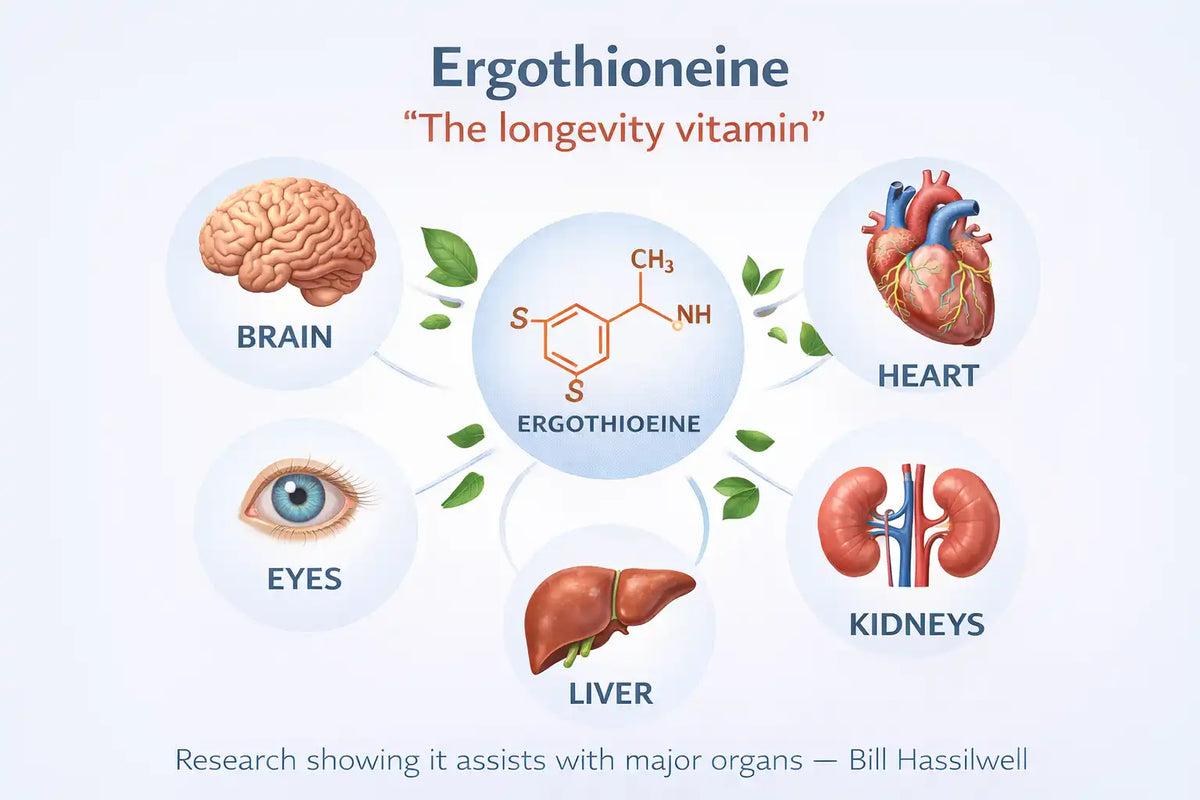
Ergothioneine has subsequently been detected in numerous tissues, including the brain, liver, kidneys, eyes and blood cells.
This selective transport and accumulation has become one of the central questions in ergothioneine research:
Why has human biology retained such an effective mechanism for acquiring a molecule that we cannot manufacture ourselves?
There is not yet a definitive answer. But researchers increasingly suspect that ergothioneine may contribute to cellular defence, particularly in tissues exposed to oxidative and metabolic stress.
More than just another antioxidant?
Ergothioneine is frequently described as an antioxidant, but that description may eventually prove too simplistic.
Research has investigated its potential antioxidant, anti-inflammatory and cytoprotective properties. More recent work is beginning to explore something potentially more interesting: whether ergothioneine participates directly in cellular signalling and mitochondrial function.
Mitochondria are the structures responsible for producing much of the energy used by our cells. Maintaining mitochondrial function becomes increasingly important as we age.
In 2025, Sprenger and colleagues reported in Cell Metabolism that ergothioneine accumulated in muscle mitochondria in response to exercise training and interacted directly with an enzyme called MPST (3-mercaptopyruvate sulfurtransferase).
The researchers found that activation of this pathway influenced mitochondrial respiration and exercise performance in experimental models. This is important because it suggests ergothioneine may do considerably more than simply encounter and neutralise reactive molecules.
It may participate in the biochemical machinery controlling cellular energy metabolism. That does not mean taking ergothioneine has been proven to increase exercise performance or mitochondrial function in humans. Much of this mechanistic work remains preclinical.
But it provides scientists with something extremely valuable: a plausible biological pathway explaining why the body might actively accumulate ergothioneine.
Ergothioneine and the Biology of Ageing
Interest in ergothioneine has increasingly moved into the field of healthy ageing and geroscience.
A 2026 systematic review examining research published between 2005 and 2025 described ergothioneine as a potential geroprotective compound and evaluated its possible relationship with several biological processes associated with ageing, including:
- mitochondrial integrity;
- oxidative stress;
- inflammatory signalling;
- telomere maintenance;
- cellular protective pathways; and
- age-associated neurological, cardiovascular and metabolic changes.
This does not establish ergothioneine as an anti-ageing treatment. Rather, it tells us where the science is heading.
Researchers are increasingly asking whether maintaining adequate dietary ergothioneine across the lifespan could be relevant to healthspan, the period of life spent in relatively good health, rather than simply lifespan.
What about the brain?
One of the most closely watched areas of ergothioneine research is cognitive ageing. Observational research has previously identified associations between lower circulating ergothioneine and cognitive impairment. Associations, however, cannot establish that low ergothioneine causes cognitive decline.
Intervention studies are therefore particularly important. A small randomised, double-blind, placebo-controlled study published by Yau and colleagues followed 19 adults aged 60 years and older with mild cognitive impairment.
Participants received either placebo or 25 mg ergothioneine three times per week for approximately one year.
The study reported encouraging signals involving aspects of learning performance and neurofilament light chain, a biomarker associated with neuronal injury.
Importantly, the researchers also found that ergothioneine supplementation did not adversely affect the clinical safety measures monitored during the study.
However, this was a 19-person pilot trial. It should therefore be regarded as promising preliminary human evidence rather than proof that ergothioneine prevents dementia or treats cognitive impairment.
A larger human trial provides more perspective
Another randomised, double-blind, placebo-controlled trial published in 2025 studied 147 adults aged 55–79 years who reported subjective memory concerns.
Participants received either:
- 10 mg ergothioneine per day;
- 25 mg per day; or
- placebo
for 16 weeks.
Blood ergothioneine concentrations increased substantially and in a dose-dependent manner, demonstrating that orally consumed ergothioneine was being absorbed.
Some potentially favourable changes were observed, including measures relating to prospective memory and sleep initiation at the higher dose.
However, the overall cognitive results were mixed.
An improvement in composite memory was observed within the 25 mg group at week four, but this effect was not sustained across the full study period, while several other cognitive outcomes showed limited or no significant effects.
That distinction is important. The trial adds to evidence that ergothioneine can be absorbed and appears well tolerated at the doses studied, but it does not establish ergothioneine as a treatment for memory loss.
Larger and longer independent studies are still needed.
The fascinating connection between soil, fungi and ergothioneine
There is another part of this story that extends far beyond supplements.
It begins underneath our feet.
Although plants contain ergothioneine, evidence suggests that they acquire it through interactions with microorganisms within the soil rather than synthesising it themselves.
That means the amount of ergothioneine entering our food supply may partly depend upon the biological health of agricultural soils.
Researchers from Penn State investigated this relationship by comparing ergothioneine concentrations in maize, soybeans and oats grown under different tillage systems.
Across all three crops, ergothioneine concentrations declined as soil disturbance increased.
Moving from no-till agriculture to intensive ploughing was associated with reductions of approximately 30%.
This creates a remarkable nutritional chain:
SOIL → FUNGI & MICROORGANISMS → PLANTS → ANIMALS → HUMANS
Disrupt the fungal ecology of the soil and we may also alter the micronutrient composition of the food growing above it.
This is an emerging field and should not be overstated. Nevertheless, it provides another reason why researchers interested in human nutrition are increasingly paying attention to soil microbiology and regenerative agriculture.
Mushrooms are different
Plants may acquire ergothioneine.
Fungi can make it.
That distinction helps explain why mushrooms are such important dietary sources.
Ergothioneine concentrations vary substantially between mushroom species, strains, growing conditions, substrates, maturity and post-harvest handling. Some wild mushrooms, including certain Boletus species such as porcini, have been reported to contain particularly high concentrations.
Cultivated mushrooms are also important sources.
Species within the Pleurotus genus, the oyster mushroom family, have attracted particular research interest.
For growers, this raises a fascinating question:
Can cultivation practices influence the ergothioneine concentration of the mushroom itself?
Genetics, substrate composition, environmental conditions, developmental stage and harvesting practices may all potentially influence the biochemical composition of a fruiting body. (Areas that OMG Mushrooms is investigating with CSIRO through their innovate to grow program).
This moves the conversation beyond simply asking:
Which mushroom contains ergothioneine?
A more interesting question may eventually become:
How can we grow nutritionally superior mushrooms?
Food first: Putting mushrooms back on the plate
The excitement surrounding ergothioneine inevitably creates interest in isolated supplements. But there is another, much simpler way of looking at the research.
Eat mushrooms.
Mushrooms provide ergothioneine as part of a considerably larger nutritional matrix containing fibre, beta-glucans, proteins, minerals and numerous other fungal compounds.
That does not mean eating mushrooms has been proven to prevent Alzheimer's disease, cardiovascular disease or biological ageing.
It has not. It simply means that increasing dietary diversity to include edible mushrooms provides a natural food source of a compound that human biology appears unusually well equipped to absorb and retain.
For a molecule whose physiological significance is still being uncovered, that is already a compelling reason to put mushrooms on the menu.
What we know, — and what we don't
Ergothioneine research is exciting precisely because there are still unanswered questions.
- We know that humans obtain ergothioneine through their diet.
- We know that fungi are major natural producers and mushrooms are among its richest dietary sources.
- We know that humans possess the OCTN1 transport system capable of absorbing and concentrating ergothioneine.
- We know that supplementation can substantially increase circulating ergothioneine concentrations.
And increasingly sophisticated laboratory research is revealing mechanisms through which ergothioneine may interact with mitochondrial function, oxidative stress and cellular signalling.
What we do not yet know is equally important.
- We do not have sufficient evidence to say that ergothioneine prevents Alzheimer's disease, Parkinson's disease, cardiovascular disease or other age-associated conditions.
- We do not yet know the optimal human intake.
- And we do not yet know whether maintaining higher ergothioneine concentrations across decades meaningfully extends human healthspan.
Those questions require much larger and longer clinical studies.
A nutrient worth watching
There is something beautifully circular about the ergothioneine story. A molecule produced predominantly by fungi enters our food chain through mushrooms and biologically active soils.
Humans cannot manufacture it.
Yet our bodies possess specialised biological machinery capable of absorbing and retaining it.
More than a century after ergothioneine was first identified, scientists are finally beginning to understand what that relationship might mean.
Perhaps ergothioneine will ultimately earn the description “longevity vitamin.” Perhaps the evidence will lead somewhere more nuanced.
Science has not answered that question yet.
But one conclusion is becoming increasingly difficult to ignore:
Fungi contribute far more to human nutrition than we once realised.
And sometimes the future of nutrition begins with understanding what has been quietly growing beneath our feet all along.
References & further reading
Yau YF, Cheah IK, Mahendran R, et al. (2024). Investigating the efficacy of ergothioneine to delay cognitive decline in mild cognitively impaired subjects: A pilot study. Journal of Alzheimer's Disease, 102(3), 841–854.
PubMed – Yau et al. study
Sprenger HG, Mittenbühler MJ, Sun Y, et al. (2025). Ergothioneine controls mitochondrial function and exercise performance via direct activation of MPST. Cell Metabolism, 37(4), 857–869.e9.
PubMed – Sprenger et al. study
Zajac IT, Kakoschke N, Kuhn-Sherlock B, May-Zhang LS. (2025). The Effect of Ergothioneine Supplementation on Cognitive Function, Memory, and Sleep in Older Adults with Subjective Memory Complaints: A Randomized Placebo-Controlled Trial. Nutraceuticals, 5(3), 15.
Zajac et al. randomised controlled trial
Beelman RB, Richie JP, Phillips AT, Kalaras MD, Sun D, Duiker SW. (2021). Soil disturbance impact on crop ergothioneine content connects soil and human health. Agronomy, 11(11), 2278.
Penn State – Beelman et al. study
Zheng J, Gong M, Meng X, Hou Z. (2026). Ergothioneine: An updated review on preparation strategies, biological activity and mechanisms, health and functional applications. Food Chemistry.
PubMed – 2026 Ergothioneine Review
Ergothioneine as a potential geroprotector: Targeting molecular hallmarks of ageing and age-related diseases. (2026). Ageing Research Reviews.
PubMed – 2026 Geroprotector Review
This article is provided for educational purposes and discusses emerging nutritional research.
Blog posts
Ergothioneine: The Mushroom Nutrient Emerging in the Science of Healthy Ageing
Why scientists are taking a closer look at this unusual compound, and why mushrooms sit at the centre of the story For more than a century, a little-known compound called ergothioneine has been qui...
Read more